 Undergraduate
Technology becomes truly meaningful when it responds to real needs in everyday life, particularly for communities facing barriers to communication and access to information. Through “CTU-SignBridge,” Can Tho University (CTU) is developing an artificial intelligence (AI) - powered solution for sign language recognition while further refining the technology based on the experiences of the deaf and speech-impaired community.
On September 17, 2026, CTU organized a session to introduce, transfer, and provide hands-on experience with “CTU-SignBridge” at Soc Trang Special Education School in Can Tho City. The activity provided teachers and students with an opportunity to use the software directly and discuss with the project development team practical requirements for recognizing and using sign language.
The activity was carried out under the project, “Activating Innovation for Inclusive and Sustainable Development” as part of the Resilient Agriculture & Food of the Aus4Innovation program. The project is implemented by CTU in collaboration with the Commonwealth Scientific and Industrial Research Organisation (CSIRO), Australia.

CTU organized a session to introduce, transfer, and provide hands-on experience with “CTU-SignBridge” at Soc Trang Special Education School in Can Tho City (Photo: CTU-SignBridge Development Team)
Bringing AI Closer to Real-World Communication Needs
“CTU-SignBridge” is being developed to enable two-way conversion among sign language, text, and speech, thereby supporting communication between deaf and speech-impaired people and hearing people.
During the demonstration and hands-on experience session, the development team introduced how “CTU-SignBridge” works, its sign language recognition capabilities, and potential applications. Teachers and students received direct guidance on operating the software, performing signs, and experiencing the application in a real-world setting. Bringing “CTU-SignBridge” into a special education school was not only a step in testing the technology but also opened up an opportunity for the system to be used in real-life communication contexts. This enabled the research team to observe how the software responded, identify what worked well, and note areas requiring further improvement.
One of the issues discussed was the diversity of ways in which signs can be performed. The same sign may vary in hand position, orientation, distance, speed, and angle of movement among users. For an AI-based recognition system, each of these variations presents a challenge in terms of data and processing capabilities. Therefore, teachers from the School for Special Education recommended further expanding the data pool to cover more users, variations in sign performance, and diverse viewing angles, enabling the system to improve its recognition accuracy in real-world situations.
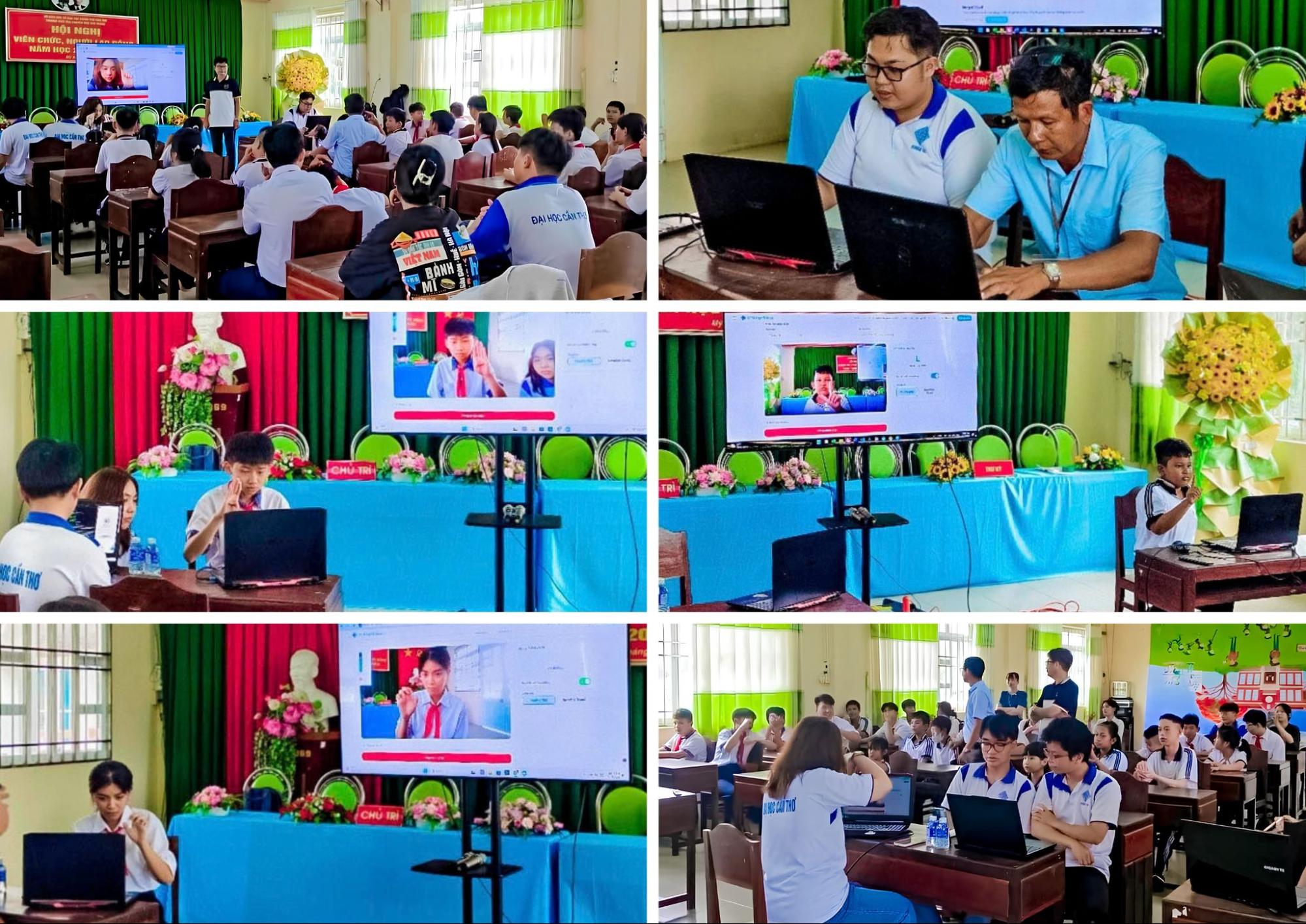
The “CTU-SignBridge” development team and students from Soc Trang Special Education School directly experience the application (Photo: CTU-SignBridge Development Team)
The Community Does Not Just Use Technology — It Helps Develop It
An important aspect of the technology transfer was not only the opportunity to put a technological product into real-world use, but also to enable direct dialogue between the development team and users. Teachers who use sign language every day in teaching and communicating with students provided practical feedback, helping the development team better understand the requirements that the technology needs to meet.
One key requirement was the need to expand and diversify the dataset, as the same sign may vary in hand position, orientation, distance, speed, and angle of movement among users. Processing speed, the ability to recognize sequences of signs and connect them into complete sentences, as well as enhancing visual clarity through the integration of signs, images, and text, were also identified as areas for further development. These insights provide a basis for the development team to expand the dataset, validate the system, and refine its performance in real-world use cases.
With “CTU-SignBridge,” the community is not merely a beneficiary of technology but also a part of the technology development process. The participation of teachers and sign language users helps shape the solution based on diverse experiences and needs, gradually bringing the technology closer to everyday life. The experiences and feedback gathered at Soc Trang Special Education School in Can Tho City provide the software development team with a stronger basis for further refining “CTU-SignBridge” in line with users’ needs.
Starting from the challenge of sign language recognition, “CTU-SignBridge” opens up a broader perspective on the role of science, technology, and innovation in inclusive development. When technology is developed together with its users, advances in AI can go beyond system-level processing capabilities to help expand opportunities for communication, learning, access to information, and social participation for deaf and speech-impaired communities in the digital age.
(Website Editorial Board)